Thursday, January 9, 2014
Simple 15V And 5V Car Battery Supply Circuit Diagram
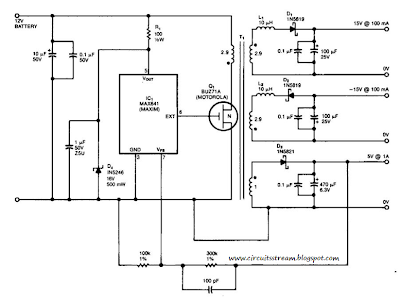
This is a Simple 15V And 5V Car Battery Supply Circuit Diagram. In this circuit use IC1 is a switching regulator that generates a 45-kHz signal that drives the gate of MOSFET Ql. Dl, D2, and D3 are Schottky diodes. The 5-V output is sensed as a reference; feedback to the chip turns off the gate signal to Ql if the voltage rises above 5 V.
Tl has Trifilar windings that assume about 2% regulation for a 10-to 100-mA load change on the ± 15-V supplies. R1/D4 provide over-voltage protection. Tl has a primary inductance of about 21 . Core size should allow 4-A peak currents. The turn ratios are IIV2 turns each for the 15-V supplies, ll1/2 turns for the primary, and four turns for the 5-V secondary. The efficiency is about 75%.
Simple 15V And 5V Car Battery Supply Circuit Diagram

Friday, December 27, 2013
Simple Tone Control by using Discrete Components
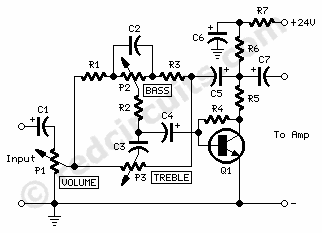
Simple Tone Control specifically designed for the 3 - 5 Watt Class-A audio amplifiers. Traditional Bass, Treble Controls and DC 24V power supply. A Bass and Treble frequency control to be added to the 3 - 5W Class-A Amplifier was required by some audio enthusiasts. Therefore, this circuit has been designed keeping in mind the extreme simplicity of the amplifier circuit to which it should be linked and was carried out using as few as components possible.
P1______________47K Log. Potentiometer (See Notes)
P2,P3___________47K Linear Potentiometers
R1,R3,R5_________4K7 1/4W Resistors
R2______________22K 1/4W Resistor
R4_______________1M 1/4W Resistor
R6_______________1K8 1/4W Resistor
R7_____________560R 1/4W Resistor
C1,C4,C5,C7_____10µF 63V Electrolytic Capacitors (See Notes)
C2______________47nF 63V Polyester Capacitor
C3_______________1nF 63V Polyester Capacitor (See Notes)
C6_____________220µF 35V Electrolytic Capacitor
Q1____________BC550 45V 100mA NPN Low noise High gain NPN Transistor
Q1 is the only active component forming a straightforward single-stage transistor amplifier with the tone control network in the ac feedback path. Taking this feedback from the split load of Q1 we obtain an ac stage gain of about 3: this can be useful to cope with low output voltage audio sources.
Readmore...
 |
| Simple Tone Control Circuit Diagram |
Parts
P1______________47K Log. Potentiometer (See Notes)
P2,P3___________47K Linear Potentiometers
R1,R3,R5_________4K7 1/4W Resistors
R2______________22K 1/4W Resistor
R4_______________1M 1/4W Resistor
R6_______________1K8 1/4W Resistor
R7_____________560R 1/4W Resistor
C1,C4,C5,C7_____10µF 63V Electrolytic Capacitors (See Notes)
C2______________47nF 63V Polyester Capacitor
C3_______________1nF 63V Polyester Capacitor (See Notes)
C6_____________220µF 35V Electrolytic Capacitor
Q1____________BC550 45V 100mA NPN Low noise High gain NPN Transistor
Q1 is the only active component forming a straightforward single-stage transistor amplifier with the tone control network in the ac feedback path. Taking this feedback from the split load of Q1 we obtain an ac stage gain of about 3: this can be useful to cope with low output voltage audio sources.
5 LED VU meter circuit diagram using KA2284
This is a simple circuit diagram of 5-LED audio VU meter using IC KA2284/KA2285. The KA2284, KA2285 are monolithic integrated circuit. It is a logarithmic display driver IC. And it is Bar type display driver using 5-Dot LED. The KA2284/KA2285 has a wide range supply voltage capacity of 3.5V-16V, but we recommend to use about a 12VDC power supply.
Circuit Diagram:
 |
| Fig: 5-LED Dot/Bar (VU meter) circuit diagram |
Usability of this circuit:
- AC signal Meter or DC Level meter.
- Audio VU(Volume Unit) meter in amplifier or such kind of device.
Here IC AN6884 is also can be used instead of KA2284,KA2285. These all are almost same.
Further reading: DOT vs BAR
Further reading: DOT vs BAR
Thursday, December 26, 2013
Reanimating Probe for AVR μC
AVR device not responding, When this discouraging message appears while you’re programming your Atmel microcontroller, that’s where the problems really begin! The problem is of ten due to incorrect programming of the fuse bits. This is where the unblocking probe comes into play.

Once the whole thing is powered up, all you have to is use one hand to apply the tip of the probe to the microcontroller’s XTAL1 input and then use your other hand to go ahead and program it with your favourite sof t ware. And there, your microcontroller is saved! The electronics are as simple as can be, the aim being to design something cheap and easy to reproduce. It consists of an oscillator generating a rectangular wave at around 500 kHz, built using a 74HC04. This circuit will also work with a 74HC14, but depending on the make of IC, the frequency of around 500 kHz may vary by around ±50 kHz. This doesn’t affect the operation of the probe.
Reanimating Probe for AVR μC Circuit diagram :

The unblocking board is connected using a ribbon cable, terminated with two female HE10/10 connectors. The pinout of the HE10/10 connector is the same as used in the majority of circuits, but of course it can be adapted for an HE10/06 connector.
The first connector is connected to the board to be unblocked, which allows powering of the electronics. The second connector is connected to the ISP programmer (STK200 compatible). The contact at the crystal is made using a needle, to ensure contact even through a board that has been varnished. There’s no need to unsolder the crystal for this operation.
The PCB design in Eagle format is available from : www.elektor.com
Author : P. Rondane - Copyright : elektor
Source :http://www.ecircuitslab.com/2012/08/reanimating-probe-for-avr-c.html
Triangular Wave Oscillator
This design resulted from the need for a partial replacement of the well-known 8038 chip, which is no longer in production and there fore hardly obtainable.
An existing design for driving an LVDT sensor (Linear Variable Differential Transformer), where the 8038 was used as a variable sine wave oscillator, had to be modernised. It may have been possible to replace the 8038 with an Exar 2206, except that this chip couldn’t be used with the supply voltage used. For this reason we looked for a replacement using standard components, which should always be available.
Triangular Wave Oscillator Circuit diagram:

In this circuit two opamps from a TL074 (IC1.A and B) are used to generate a triangular wave, which can be set to a wide range of frequencies using P1. The following differential amplifier using T1 and T2 is configured in such a way that the triangular waveform is converted into a reasonably looking sinusoidal waveform. P2 is used to adjust the distortion to a minimum.
The third opamp (IC1.C) is configured as a difference amplifier, which presents the sine wave at its output. This signal is then buffered by the last opamp (IC1.D). Any offset at the output can be nulled using P3.
Author : Jac Hettema - Copyright : Elektor
Source : http://www.ecircuitslab.com/2012/06/triangular-wave-oscillator.html
Wednesday, December 25, 2013
DIY Infrared Radar System
Chris from PyroElectro.com has a great article about a do-it-yourself radar system build with PIC18F452. It’s a great hobby project although the schematic is very complicated. This project uses three main devices to create the personal radar system. The IR Range sensor gives output, the pic microcontroller processes it and then displays the output on the led array.
DIY Infrared Radar Circuit Schematic

The goal of this project is to create a working ir radar system. The system will only be required to measure close proximity at an angle of 90 degrees as seen in the example above. The range of system is roughly 4-30cm, 20-150cm & 1m-5.5m depending upon which sensor you choose to use. [Link]DIY Infrared Radar Circuit Schematic
Telephone Conversation recorder
This circuit enables automatic switching-on of the tape recorder when the handset is lifted. The tape recorder gets switched off when the handset is replaced. The signals are suit-ably attenuated to a level at which they can be recorded using the MICIN socket of the tape recorder. Points X and Y in the circuit are connected to the telephone lines. Resistors R1 and R2 act as a voltage divider.
The voltage appearing across R2 is fed to the MIC-IN socket of the tape recorder. The values of R1 and R2 may be changed depending on the input impedance of the tape recorders MIC-IN terminals. Capacitor C1 is used for blocking the flow of DC. The second part of the circuit controls relay RL1, which is used to switch on/off the tape recorder.A voltage of 48 volts appears across the telephone lines in on-hook condition. This voltage drops to about 9 volts when the handset is lifted. Diodes D1 through D4 constitute a bridge rectifier/polarity guard.
Telephone Conversation recorder Circuit Diagram

This ensures that transistor T1 gets voltage of proper polarity, irrespective of the polarity of the telephone lines.During on-hook condition, the output from the bridge (48V DC) passes through 12V zener D5 and is applied to the base of transistor T1 via the voltage divider comprising resistors R3 and R4. This switches on transistor T1 and its collector is pulled low. This, in turn, causes transistor T2 to cut off and relay RL1 is not energised. When the telephone handset is lifted, the voltage across points X and Y falls below 12 volts and so zener diode D5 does not conduct.
As a result, base of transistor T1 is pulled to ground potential via resistor R4 and thus is cut off. Thus, base of transistor T2 gets forward biased via resistor R5, which results in the energisation of relay RL1. The tape recorder is switched on and recording begins. The tape recorder should be kept loaded with a cassette and the record button of the tape recorder should remain pressed to enable it to record the conversation as soon as the handset is lifted. Capacitor C2 ensures that the re-lay is not switched on-and-off repeatedly when a number is being dialled in pulse dialling mode.
Source: http://www.ecircuitslab.com/2011/10/telephone-conversation-recorder.html
Subscribe to:
Posts (Atom)