Showing posts with label discrete. Show all posts
Showing posts with label discrete. Show all posts
Friday, December 27, 2013
Simple Tone Control by using Discrete Components
Simple Tone Control specifically designed for the 3 - 5 Watt Class-A audio amplifiers. Traditional Bass, Treble Controls and DC 24V power supply. A Bass and Treble frequency control to be added to the 3 - 5W Class-A Amplifier was required by some audio enthusiasts. Therefore, this circuit has been designed keeping in mind the extreme simplicity of the amplifier circuit to which it should be linked and was carried out using as few as components possible.
P1______________47K Log. Potentiometer (See Notes)
P2,P3___________47K Linear Potentiometers
R1,R3,R5_________4K7 1/4W Resistors
R2______________22K 1/4W Resistor
R4_______________1M 1/4W Resistor
R6_______________1K8 1/4W Resistor
R7_____________560R 1/4W Resistor
C1,C4,C5,C7_____10µF 63V Electrolytic Capacitors (See Notes)
C2______________47nF 63V Polyester Capacitor
C3_______________1nF 63V Polyester Capacitor (See Notes)
C6_____________220µF 35V Electrolytic Capacitor
Q1____________BC550 45V 100mA NPN Low noise High gain NPN Transistor
Q1 is the only active component forming a straightforward single-stage transistor amplifier with the tone control network in the ac feedback path. Taking this feedback from the split load of Q1 we obtain an ac stage gain of about 3: this can be useful to cope with low output voltage audio sources.
Readmore...
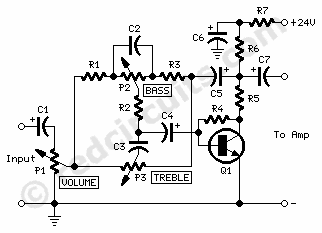 |
| Simple Tone Control Circuit Diagram |
Parts
P1______________47K Log. Potentiometer (See Notes)
P2,P3___________47K Linear Potentiometers
R1,R3,R5_________4K7 1/4W Resistors
R2______________22K 1/4W Resistor
R4_______________1M 1/4W Resistor
R6_______________1K8 1/4W Resistor
R7_____________560R 1/4W Resistor
C1,C4,C5,C7_____10µF 63V Electrolytic Capacitors (See Notes)
C2______________47nF 63V Polyester Capacitor
C3_______________1nF 63V Polyester Capacitor (See Notes)
C6_____________220µF 35V Electrolytic Capacitor
Q1____________BC550 45V 100mA NPN Low noise High gain NPN Transistor
Q1 is the only active component forming a straightforward single-stage transistor amplifier with the tone control network in the ac feedback path. Taking this feedback from the split load of Q1 we obtain an ac stage gain of about 3: this can be useful to cope with low output voltage audio sources.

Wednesday, September 4, 2013
Build an op amp with three Discrete Transistors
You can use three discrete transistors to build an operational amplifier with an open-loop gain greater than 1 million (Figure 1). You bias the output at approximately one-half the supply voltage using the combined voltage drops across zener diode D1, the emitter-base voltage of input transistor Q1, and the 1V drop across 1-MΩ feed-back resistor R2.
Resistor R3 and capacitor C1 form a compensation network that prevents the circuit from oscillating. The values in the figure still provide a good square-wave response. The ratio of R2 to R1 determines the inverting gain, which is −10 in this example.
You can configure this op amp as an active filter or as an oscillator. It drives a load of 1 kΩ. The square-wave response is good at 10 kHz, and the output reduces by 3 dB at 50 kHz. Set the 50-Hz low-frequency response with the values of the input and the output capacitors. You can raise the high-frequency response by using faster transistors and doing careful layout. Link
 | |
| Figure 1. | This ac-coupled inverting op amp has an open-loop gain of 1 million. R1 and R2 set a closed-loop gain of −10. |
Resistor R3 and capacitor C1 form a compensation network that prevents the circuit from oscillating. The values in the figure still provide a good square-wave response. The ratio of R2 to R1 determines the inverting gain, which is −10 in this example.
You can configure this op amp as an active filter or as an oscillator. It drives a load of 1 kΩ. The square-wave response is good at 10 kHz, and the output reduces by 3 dB at 50 kHz. Set the 50-Hz low-frequency response with the values of the input and the output capacitors. You can raise the high-frequency response by using faster transistors and doing careful layout. Link
Subscribe to:
Posts (Atom)